Basics in plain language
What to hold, base mix, time-left schedule.
By Leo HongReviewed 7 min read
On this page
What you can hold#
-
Cash/HISA — high-interest savings account: pays interest. The Canada Deposit Insurance Corporation (CDIC) insures eligible deposits up to limits at member banks; provincial plans do the same at covered credit unions. Your paycheque and your bank accounts explains coverage, including protection if a brokerage fails (missing property, not market losses); Quebec mutual-fund coverage differs, so check the firm and account. Good for emergency funds and short goals, but after tax and inflation, long-term growth can be small or negative.
-
Guaranteed investment certificate (GIC): you lock money away for months to years at a guaranteed rate. CDIC covers it if the issuer is a member and the terms qualify. A cashable GIC lets you take money out early, usually at a lower rate. A non-redeemable GIC locks it until its end date. Suits spending on a known date 1–5 years out. A GIC ladder splits that spending across GICs that each mature before their money is needed. Don’t lock up money you might need sooner.
-
Bonds: loans to governments and corporations. They pay interest. Their prices usually fall when rates rise, and rise when rates fall. A Canadian aggregate bond fund (for example ZAG; illustration, not endorsement) holds hundreds of bonds, so if one borrower fails to pay, it barely affects the fund. Bonds swing less than stocks and have a lower expected long-term return. Bond “duration” (how much the price moves when rates change) decides which job a fund fits:
- Short bonds: less rate-sensitive, but still able to lose value.
- Mid (aggregate): the default all-rounder for rebalancing.
- Long bonds: most rate-sensitive, with larger swings.
Default: a Canadian aggregate fund to steady a long-term portfolio; insured savings or timed GICs for a near-term amount you need in full.
-
Stocks/equities: slices of businesses. Prices swing yearly, but the expected return over decades is higher because you carry business risk. A broad all-equity fund (for example VEQT; illustration, not endorsement) holds thousands of stocks globally, so one company’s collapse barely affects the fund.
-
Index fund: a mutual fund or exchange-traded fund (ETF) that tracks a market index (e.g., total Canada, total U.S., total international). It spreads your money across that market and aims for its return, minus costs. That is the edge: you don’t need to pick winners in advance.
Risk, horizon, and the base mix#
- Inflation and shortfall are risks too. A HISA at 3% earns ~1% real (after inflation) before tax. For a 30-year-old, the biggest risk is not a 50% dip but earning that for 30 years and falling short. That is why long-term money needs growth assets: match volatility to your time horizon.
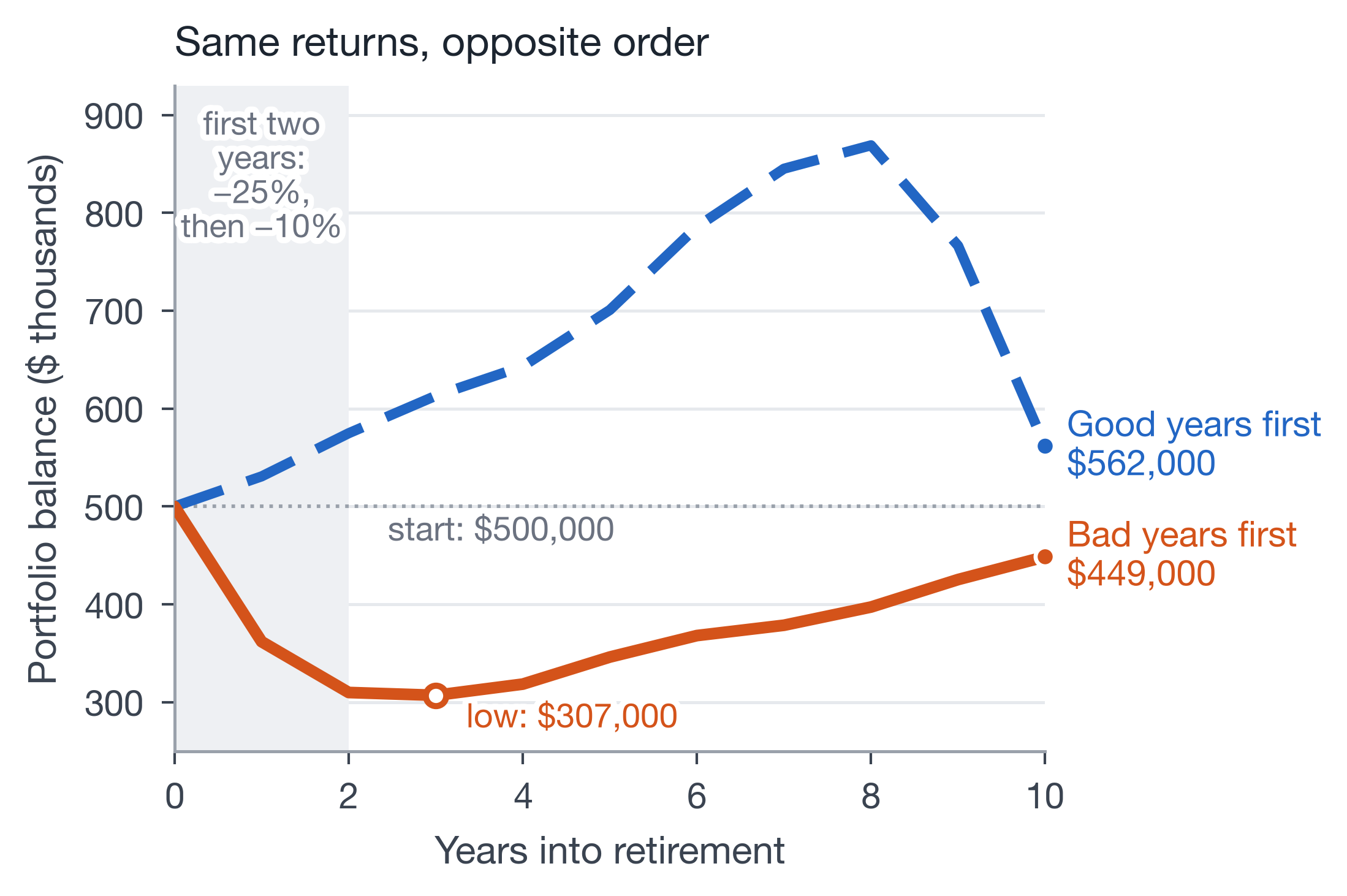
- Sequence-of-returns risk — the decade around your final paycheque behaves differently. A 20% drop at 35 is a sale while you keep buying. The same drop at 65, while you withdraw, means selling at bottom prices as you retire. The damage does not fully heal, because dollars sold in the crash miss the recovery. The risk peaks in the ~5 years before and after the last paycheque. Plan for that window, not just the retirement average. In the chart below, two retirees each start with $500,000, withdraw $17,500 a year, and get the same ten returns in opposite order. Bad years first ends at about $449,000; good years first ends at about $562,000.
-
Goals and risk profile — the ceiling is the lower of capacity and tolerance (see risk done right). Your goals set the return you need (see lifecycle and human capital). When that is more than the ceiling supports, fix the inputs (save more, work longer, trim the goal). Don’t add risk. What the money must do matters more than your age; time horizon is only a shorthand for it. How they interact:
- Stable job, good pension: capacity is high, so you could take more risk. Your goals may not call for it. Take extra risk only on purpose (for a cushion or a legacy), and only as far as your tolerance has been tested.
- Started late: your goals need more return, but your capacity to take risk may be smaller, so the default is still to fix the inputs. Going above the ~80% base (up to 100%, only through the crash-depth gate) works if capacity holds and you have honestly tested your tolerance for that share. At 100% equity, the test is a full 50% drop: plan for it, don’t improvise.
- Retired early: withdrawals start now, including the years before Canada Pension Plan (CPP) and Old Age Security (OAS) begin, but the long horizon still supports growth assets.
Author’s take
Base case, before your own situation adjusts it: ~80% stocks in working years, ~60% in retirement. Most changes to this base come from your goals and risk capacity, not from views about markets.
Why not 100% for everyone? A quick rebound can make “I can take anything” feel proven, but a long bear market (a deep, lasting fall) is a different test. Some backtests (tests on past data) of lifetime mixes favour 100% equities under their assumptions. That does not show every reader can stay invested through the losses, and the gain from the last slice of stocks is small next to the cost of selling in a crash. The crash-depth gate sets the size of drop to rehearse.
The two wrappers#
A fund is a pool. Many investors put in money, and a manager buys the stocks and bonds for everyone at once. Each investor’s stake is recorded as units (mutual fund) or shares (ETF). You get your share of every dividend and every loss, minus the annual fee inside the fund.
- Mutual fund: Bought from a bank branch, fund company, or advisor. Priced once a day, at the value of its holdings when markets close. Usually accepts small automatic monthly buys, and often has a minimum (commonly $500–$1,000; varies). Many retail versions have a high management expense ratio (MER), the annual fund fee explained in MER, fees, and SPIVA.
- ETF: Bought like a stock, at a discount brokerage. Its price changes all day. Traditionally whole shares only (some brokerages now allow part-shares), and MERs are typically low (examples in MER, fees, and SPIVA).
The wrapper never changes the three questions: what does it hold, what does it cost, does it fit your target mix? Wrapper choice is a convenience decision, not an investing one.
You don’t need to know the future. Own the whole market cheaply, match risk to each job the money must do, and let time and contributions do the work.
Dated goals: the booking test and time-left schedule#
One plan, two layers: reserve money for real commitments using the time-left schedule below, and invest the uncommitted surplus in one diversified portfolio. Money is interchangeable. Reserving money does not mean holding it all in cash today.
The booking test — a goal gets reserved money only when it passes all three tests at once:
- You can name the amount within about 10%.
- The date is immovable: the mortgage closes on schedule, tuition starts in September, work needs the car.
- Missing it is painful: no substitute, no postponement.
How to hold booked money, by time left until the date (illustrative):
- Under 5 years: HISA or GICs timed to the date. Bond funds, even short ones, can still lose value, so use them only for a part you could see dip. A date inside 5 years gets no equity risk.
- 5–10 years: 40–60% equity.
- 10+ years: up to 80%.
Retirement is not a booked date: retirement savings follow the glide path in simple portfolios and the bridge in CPP/OAS timing, not this schedule.
As a committed date gets closer, follow the schedule, and spend the reserved money when the date arrives. If the purchase is cancelled, return what is left to the surplus and apply the booking test before giving it a new goal. A vague “someday” want is not yet a commitment: the test stops “car in 2 years, home in 5, kids in 10” from parking everything in GICs.
If a large, fixed-date purchase comes up with no reserve (especially one above ~10% of the portfolio, a prompt to review, not a safe line), reserve it under the same schedule before you commit. When a want becomes real, follow your written withdrawal and rebalancing rules, and delay optional spending rather than letting the sale depend on that month’s market. Prefer cash or a TFSA withdrawal to an RRSP withdrawal, which brings withholding, income tax, and no room back.
Risk, return, and what to plan on#
Diversification is the closest thing to a free lunch in investing. Combine assets that don’t move together, and the whole can be steadier than its parts (the theory: Investing background).
Note
Realistic returns for planning Illustrations, not promises
Stocks do not deliver a steady 10% a year. Long-run compound annual growth rates (CAGR — the smoothed yearly rate, lower than a simple average; investing background), before fees and taxes: global equities ~6–7% nominal (~4–5% real), Canadian broad bonds ~3–4% nominal (~1–2% real), HISA ~2–3% nominal (~0–1% real). After fees and tax, take-home growth is lower. Plan with realistic estimates of future returns, never the best past decade. Past performance does not predict future returns.
“Too low” is the wrong disappointment. Some hear 6–7% and quit: “That’s not 10%, why bother?” Compare it with the real alternatives, not with dreams. Cash grows weakly over the long term after inflation and tax. Chasing a “reliable 10%” can lead to concentrated bets and timing mistakes. Meanwhile, ~4–5% real doubles your purchasing power about every 14–18 years, with no effort. A boring rate is an honest one, not a defect. If your plan needs a heroic return to work, the plan is the problem. Fix the inputs instead (the started-late fix above).