Simple portfolios
One or two funds, a glide path, opening the account, and rebalancing.
By Leo HongReviewed 7 min read
Key takeaways
- One asset-allocation ETF is a complete portfolio. Two funds let you pick the exact mix, but you rebalance yourself.
- Extra funds, sector ETFs and single stocks add fees and overlap, not diversification.
- Choose a stock share you can hold through a severe drop without selling. The glide-path shape matters less.
- With two funds, check twice a year and rebalance only when a holding is 5 or more percentage points off target.
On this page
You do not need 12 funds. You need coverage and discipline. This follows the principles of Canadian Couch Potato (a Canadian index-investing blog) and Bogleheads (an index-investor community): broad diversification, low fees, a simple setup, and market-cap weighting (each company weighted by its stock-market value) as the default. One deliberate exception: a tilt to your home country (see Home bias below).
Option 1: Asset-allocation ETF (simplest)#
A single fund that holds stocks and bonds at a fixed mix and rebalances for you. Mixes are written stocks/bonds, so 80/20 means 80% stocks and 20% bonds. Examples: conservative 40/60, balanced 60/40, growth 80/20, and all-equity 100/0 ETFs from Vanguard, BlackRock, and BMO. Named as examples, not picks. Check current MERs and structure with each provider before buying.
Why it works: complexity creates avoidable failure points, such as overlapping funds, conflicting tips, and rebalancing that never happens. One fund cuts those moving parts, with global coverage and a steady mix. Not magic: just a simple default for hands-off investing.
Pros: one buy, automatic rebalancing, easy to hold, fewer decisions.
Option 2: Two-fund portfolio (equity + bond)#
Example: one global equity fund (for example VEQT) and one Canadian bond fund (for example ZAG).
Pros: you pick the exact mix (say 70/30 rather than 60/40 or 80/20). You can follow a glide path just by changing the split. New contributions can do the rebalancing, so you rarely have to sell (useful in a taxable account). Each fund’s job is easy to see. The price is discipline: you rebalance on schedule yourself.
Complexity is not better#
Simple is not “just for beginners.” Every extra fund, ETF, or single stock adds less diversification than you would guess. A common story: “Simple funds are training wheels. With experience, I can move up to individual stocks.” But years in the market do not bring an edge. SPIVA scores professionals with decades of experience and full-time research teams, and most still trail their benchmark after fees.
One core, no satellites. Stacking sector or theme ETFs (AI, energy, banks plus tech) around a core turns one clean portfolio into expensive clutter: extra fees, overlap, rebalancing headaches, and fresh excuses to chase. Adding QQC (Nasdaq-100) or VFV (S&P 500) to a broad global all-equity fund is not diversification either. That fund already holds the whole U.S. market (about 45% of the fund), so either add-on just puts more weight on the same large U.S. growth stocks. More risk, not more expected return.
Home bias#
Globally diversified equity funds already include Canada, the U.S., international, and emerging markets. One-ticket ETFs already hold ~25–30% Canada. Canada is only ~3% of the world market by value, but Vanguard Canada research (2023) suggests a deliberate tilt to Canada can make a portfolio swing less (its suggested mix is ~30% Canada). Home bias is still debated.
Author’s take
On current information, I recommend ~20–30% Canada as the home allocation, which the one-ticket ETFs above already give you. Revisit it if the research changes.
Glide paths: three shapes#
Back to the lifecycle idea: three glide-path shapes. The best one is contested. Current research favours a higher stock share held throughout your lifetime. The shapes differ in how often you change the mix, and when:
- Static: one mix for life, rebalanced on schedule, chosen to last through the withdrawal years too (e.g., ~70% equities). Simplest to own.
- Declining: the stock share falls as retirement approaches, as in a target-date fund: ~80% while working, ~60% while withdrawing. This guide’s default (see the base mix).
- Rising (a bond tent): fewer stocks around the retirement date, raised again over the following decade. It is mostly discussed for early retirement; the retirement bridge does the same job more simply.
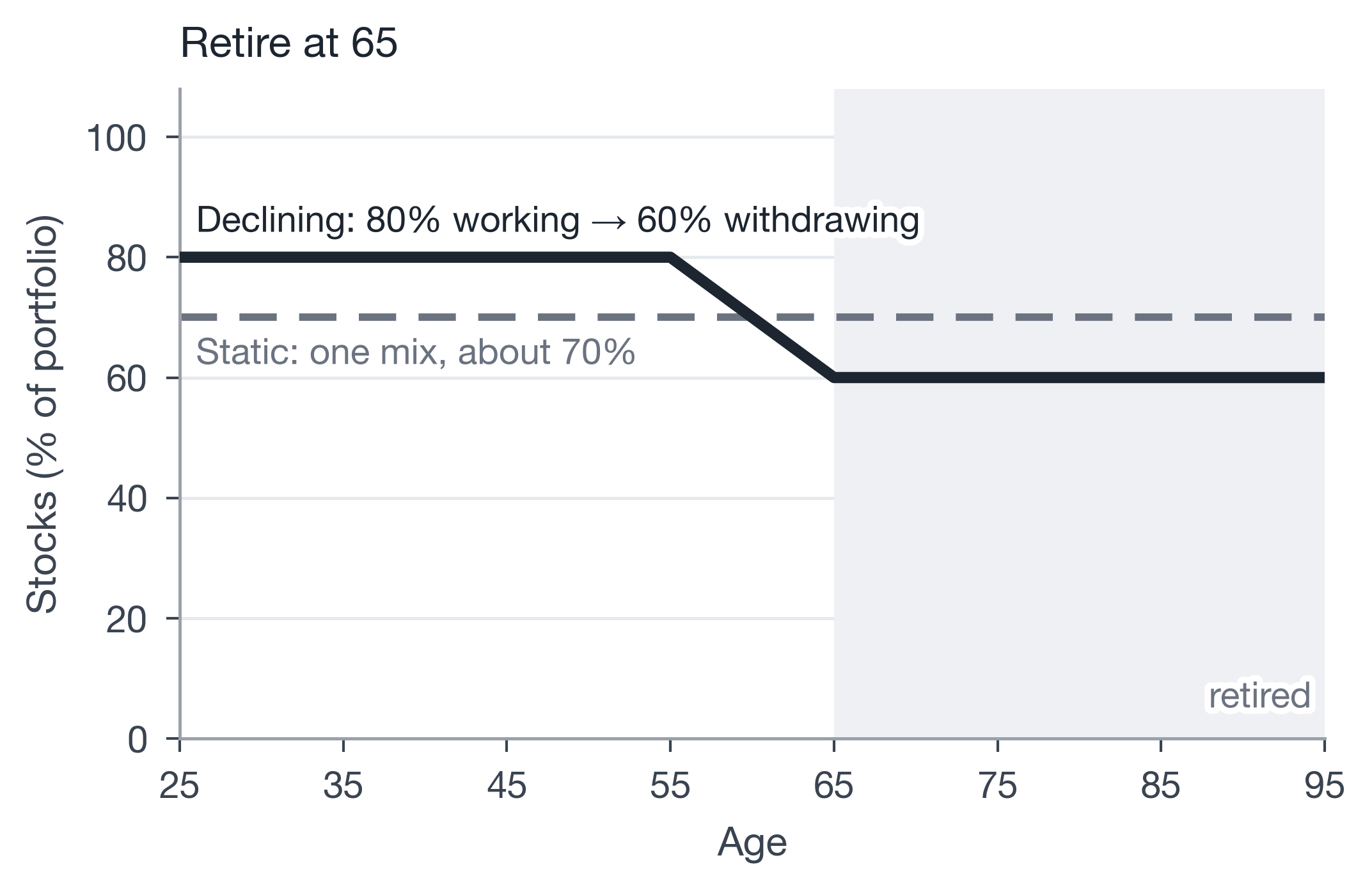
The shape matters less than holding a sensible stock share you can live with. Pick the glide path you can hold through a severe drop without selling (the crash-depth gate below sizes the drop for each mix). Lifecycle and human capital covers human capital vs financial capital.
Worksheet
The crash-depth gate Rough historical-style bounds, not forecasts
Less stock means a smaller fall to survive, but the rule for what to do in a fall stays the same.
| Equity share | Could you hold through… |
|---|---|
| 100% | a 50–55% drop |
| 80% | a 40–45% drop |
| 60% | a 30–35% drop |
| 40% | a 20–25% drop |
| 20% | a 10–15% drop |
Pick your row, then write that drop into your investment policy statement (IPS), your one-page investing rule sheet. The −20% action line is the same for every mix: below −20% (whether −25%, −50%, or deeper), follow the contribution and rebalancing plan if your cash flow and goals are unchanged. No deeper price changes the plan automatically, because nobody knows the bottom in advance. These are depths to rehearse, not worst cases. Bonds can soften losses, but can also fall, as in 2022.
Try this · 15 min
Get a starting allocation
- Take Vanguard’s questionnaire or the PWL Capital risk tool and write down its mix: a starting estimate, not a verdict.
- Pick the asset-allocation ETF closest to that mix, or set two funds to it, and set payday contributions below your confirmed account room. Raise risk only as you prove you can stay invested, never above your risk profile’s ceiling (the lower of your risk capacity and risk tolerance; see risk done right).
Opening the account#
For a DIY portfolio, open a discount brokerage account; several charge $0 to trade ETFs, such as Wealthsimple, Questrade, and National Bank Direct Brokerage (illustrations, not endorsements; check current fees). Check that the firm is a member of the Canadian Investment Regulatory Organization (CIRO), which regulates dealers, before you hand over money. Have your Social Insurance Number (SIN; required for registered accounts), photo ID, address, and a chequing account to link. Identity checks can take a few days. Open the registered account you chose with the account priority order first; don’t default to a non-registered one. Fund it by electronic transfer from your bank (a small amount is fine to start), and set up the payday contribution once the first transfer arrives.
First-purchase check#
Confirm the fund’s exact name, target mix, trading currency, and fees, then follow the provider’s purchase instructions. Buying an ETF yourself: trade while the market is open (9:30 a.m. to 4 p.m. Eastern time). Use a limit order, not a market order: you set the highest price you will pay, usually at or just above the current asking price. A scheduled deposit may only move cash, so confirm whether recurring purchases are supported and that the first purchase bought fund units.
Once your mix fits your goals and risk profile (capacity and tolerance), hold it for decades. Change it for life events, not moods. Stay loyal to the plan, not the fund.
Rebalance bands: keep it mechanical#
Asset-allocation ETFs rebalance for you, so this applies only to a two-fund portfolio (Option 2 above). Without rebalancing, winners take over and risk drifts. Rebalancing too often means needless trading and stress.
Simple system:
- Check twice a year, not daily. Birthday and tax time.
- Band rule (absolute only): If any asset is off target by ≥5 percentage points (e.g., an 80% target is now 86%; 5 points of its target share, not 5% of its own earlier value), rebalance.
- Cash-flow rule first: Send new contributions to the laggard (the holding below target). Sell only if still outside the band.
- Sheltered first: Rebalance within a TFSA, RRSP, or FHSA before selling in a taxable account. Trades within those plans generally do not trigger capital-gains tax.
Example
Rebalancing an 80/20 portfolio
The target is 80% equity / 20% bonds, so $50,000 is $40,000 / $10,000. Equities grow to $46,000 and bonds to $10,500: $56,500 total, or 81.4% / 18.6%. That is within the band: just buy bonds with your next contribution. If it drifts to 86% (+6 points), move 6 points of the total from equity to bonds (~$3,400 on $56,500), selling inside registered accounts. Or send new contributions to bonds until it is back on target. That’s the whole system.
Author’s take
Skip asset location (holding each asset in the account where it is taxed least) and keep one or two funds; the saving is small and the extra moving parts invite mistakes (investing background).
Put it in writing#
Worksheet
IPS copy-paste template Fill in
The Behaviour topic and the one-page IPS outline cover the same IPS. This is the version to copy.
Horizon __ years. Target __% equity / __% bond. Risk profile: ceiling __% stocks; I have committed to hold through a drop of __%. Check 2×/year. Rebalance at ≥5pp absolute only, new cash to laggard first, sheltered accounts first. In taxable, no gain-triggering sales for small drift. I will not pick stocks, buy crypto, or use leverage in core. If markets fall 20% or more, I follow the contribution and band rules; a further drop alone is not a reason to abandon them. If my income or spending needs change, I review the plan. Signed __ Date __.
Automation beats willpower: automatic contributions into the target mix each payday, automatic reinvestment of distributions, and a calendar reminder to check bands. The Behaviour topic has the full automation and friction systems.
Sources
- Canadian Couch Potato — model portfolios · canadiancouchpotato.com
- Bogleheads wiki — Getting started · bogleheads.org
- Vanguard investor questionnaire · investor.vanguard.com
- PWL Capital risk profile tool · research-tools.pwlcapital.com
- Vanguard Canada, home bias research (2023)